 Ethena
 First sUSDe Exit and Cooldown Planning
With the cooldown enabled, Ethena’s Ethereum staking contract separates an sUSDe exit into a request that settles shares and a later claim that releases USDe. Before committing, check the applicable cooldown and whether your wallet already has an outstanding request. Once the request succeeds, the selected shares leave your balance and their USDe waits in a holding contract. The waiting period does not automatically deliver those tokens. Plan around the recorded claim time, and treat receipt of USDe as the completed withdrawal.
The wallet, shares, and withdrawal record
An sUSDe withdrawal requires access to the wallet holding the shares, permission to use the applicable interface, and enough network gas for the transactions. A position displayed inside another application may involve additional withdrawal conditions before its shares become available. Before preparing a request, confirm that the shares are available to your wallet on Ethereum for withdrawal through the staking contract. The staking interface supports users in permitted jurisdictions; possession of the token alone does not establish interface eligibility.
The request amount also needs a clear unit. An amount of sUSDe describes vault shares, while an amount of USDe describes underlying assets. These quantities need not match numerically. The following fields distinguish the input, the waiting balance, and the eventual destination without assuming a fixed exchange rate or cooldown duration.
| Withdrawal parameter | Value or applicable condition |
|---|---|
| Share input | sUSDe available in the requesting wallet |
| Underlying asset | USDe received through settlement |
| cooldownDuration | The contract setting governing new requests |
| cooldownEnd | The recorded timestamp for the wallet’s pending claim |
| underlyingAmount | The wallet’s accumulated USDe awaiting withdrawal |
| receiver | The destination address supplied when claiming |
Request confirmation before the waiting period
A successful request transaction establishes the withdrawal position; opening a wallet prompt or signing without successful execution does not establish that state. With the cooldown enabled, settlement burns the selected sUSDe and moves the corresponding USDe into the holding contract. The wallet therefore loses those shares before it receives spendable USDe.
A lower sUSDe balance at this stage is consistent with an exit in progress. The useful comparison is between the executed request, the shares removed, and the pending USDe amount. Looking only at the wallet’s immediately spendable tokens misses the assets awaiting release. Record the transaction identifier so the original request remains distinguishable from the later claim.
Share conversion and the amount awaiting withdrawal
The USDe amount an exit settles reflects the shares’ proportionate claim on the vault’s accounted assets when the request executes. Rewards accumulate inside the staking contract, changing the USDe value represented by sUSDe. They do not require a separate reward-token withdrawal. A share balance therefore describes ownership of the vault, rather than a matching count of underlying tokens.
Reward vesting also matters at the conversion boundary. The contract makes distributed rewards available gradually, so a recently announced distribution does not mean every part already belongs in an immediately executable withdrawal amount. The relevant figure is the USDe the request actually settles. Once those assets enter cooldown, the burned shares no longer participate in subsequent vault rewards. This distinction explains why a waiting withdrawal should not be projected forward using the staking yield.
Can an sUSDe cooldown request be cancelled?
The StakedUSDeV2 cooldown mechanism has no cancellation function that restores shares after a successful request. Closing the interface cannot reverse settlement. Before submission, abandoning the unsigned request leaves the position unchanged. After confirmation, returning the settled assets to staking requires claiming USDe and making a new deposit, subject to the applicable access conditions.
The configured duration and the recorded deadline
The cooldown duration is adjustable, so an old waiting-period figure is an unreliable basis for scheduling a first exit. Read the applicable setting before requesting withdrawal, then use the recorded deadline for the pending claim.
The staking contract caps the configurable cooldown duration at 90 days. That ceiling describes administrative configuration, not the waiting period every request receives.
Another successful cooldown request adds USDe to the same wallet record and resets its deadline using the duration then in force.
An existing claim therefore deserves attention before another request. A later exit can postpone access to assets already waiting. A change between nonzero duration settings does not itself rewrite the previously stored deadline. Scheduling around the record avoids confusing the terms of a new request with those attached to an existing withdrawal.
The claim transaction and its completion evidence
A matured cooldown makes the waiting USDe claimable; it does not initiate a transfer to the wallet automatically. The holder must submit a claim transaction. In StakedUSDeV2, the claim releases the wallet record’s full underlying amount to the specified receiver and clears that record.
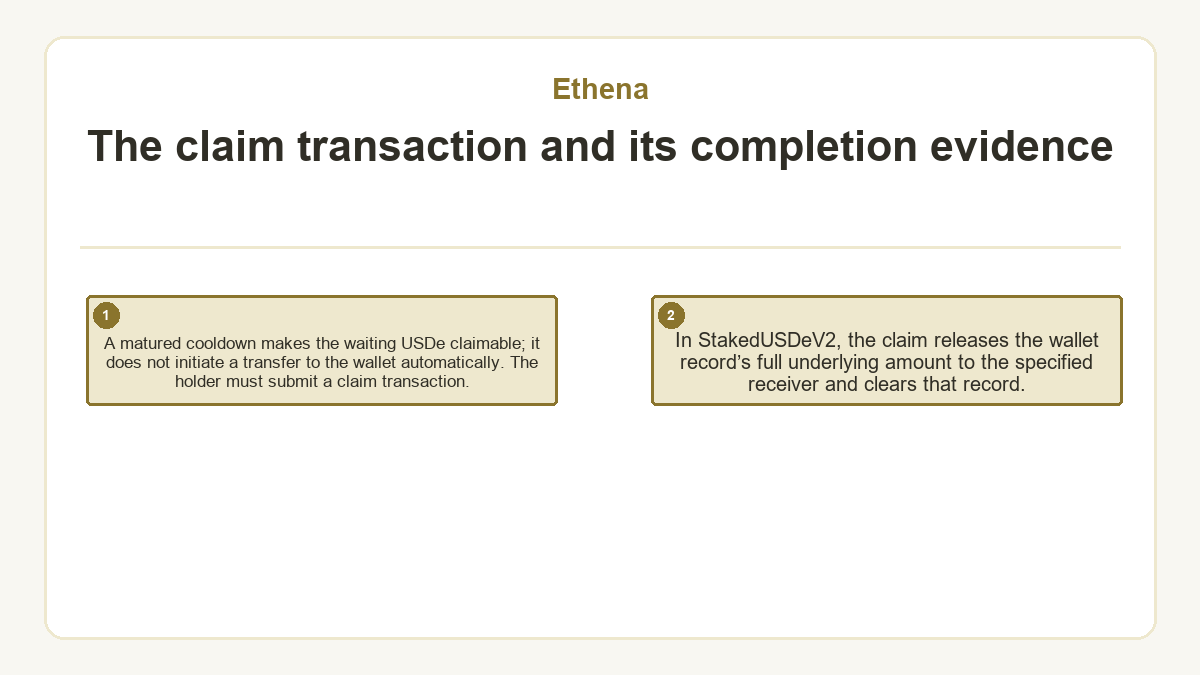
The receiver matters when reconciling the withdrawal. If the destination differs from the requesting wallet, the sender’s USDe balance will not show the incoming tokens. Check the destination recorded by the successful transaction. A cleared pending amount and the corresponding USDe transfer explain where the withdrawal went; a countdown reaching its endpoint establishes only that the waiting condition has elapsed.
Pending transactions and apparent missing balances
A pending request and a pending claim affect different stages of the exit, so a missing balance needs interpretation alongside transaction status. Before the request succeeds, the intended settlement has not completed. After settlement but before a successful claim, the USDe remains outside the recipient’s spendable balance. An interface refresh can change what the screen displays without changing either transaction’s execution.
A failed transaction does not establish the intended withdrawal state.
Keep the request and claim records separate when investigating a discrepancy. A request receipt cannot prove the later transfer occurred, and a wallet signature cannot prove execution succeeded. Likewise, a stale interface countdown does not override the contract’s recorded claim condition. Checking the specific transaction and destination is more informative than submitting an additional exit simply because the first screen appears unchanged.
The boundary between unstaking and redeeming USDe
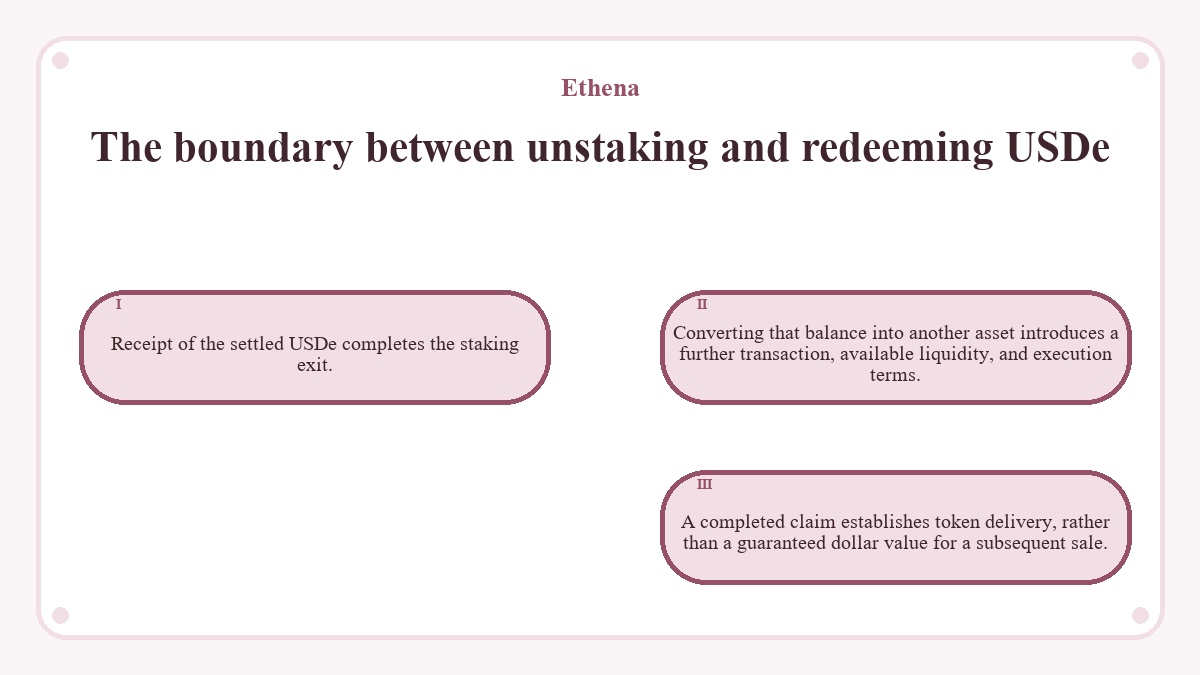
Completing the sUSDe claim leaves the recipient holding USDe, which remains a token with its own market value and transfer conditions. It does not automatically exchange USDe for backing assets or deliver money to a bank account. Direct USDe redemption is a separate process with counterparty approval requirements. Those requirements should not be confused with the mechanics of settling vault shares.
Receipt of the settled USDe completes the staking exit. Converting that balance into another asset introduces a further transaction, available liquidity, and execution terms. A completed claim establishes token delivery, rather than a guaranteed dollar value for a subsequent sale.
A market sale before committing to cooldown
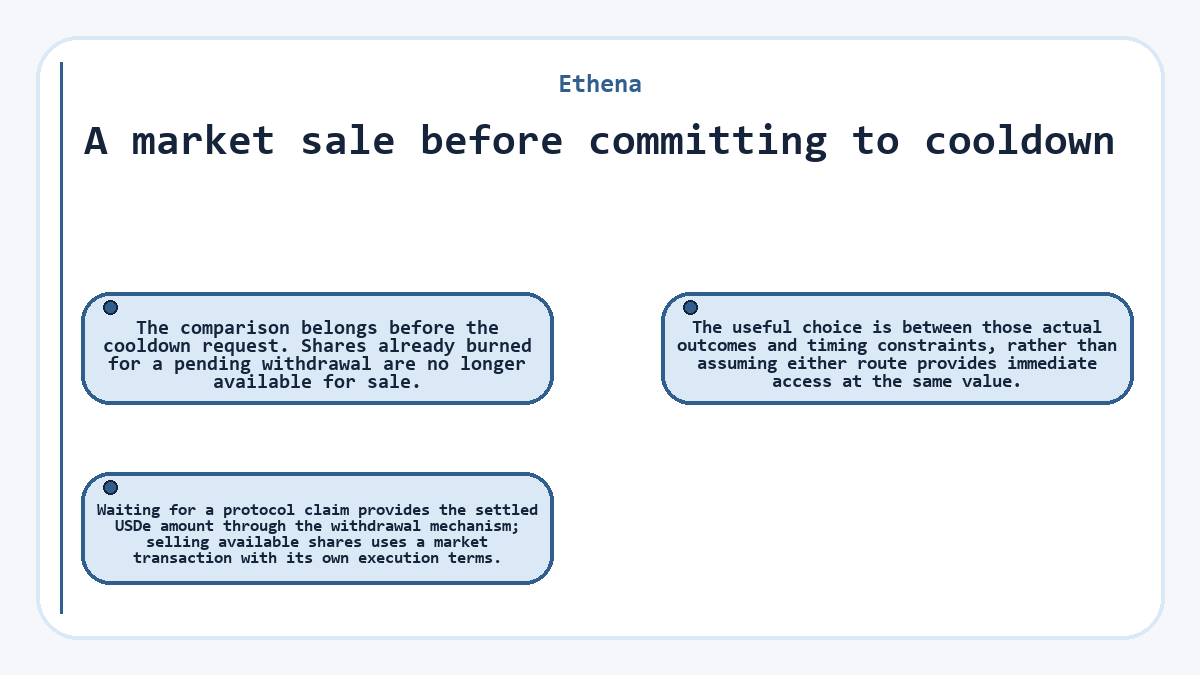
Selling transferable sUSDe through an available external market is a different exit from settling shares through the staking contract. Market access and liquidity determine whether that alternative exists for the intended amount. Its proceeds depend on the executable quote, fees, and price impact. The vault’s USDe conversion value alone does not establish what a market buyer will pay.
The comparison belongs before the cooldown request. Shares already burned for a pending withdrawal are no longer available for sale. Waiting for a protocol claim provides the settled USDe amount through the withdrawal mechanism; selling available shares uses a market transaction with its own execution terms. The useful choice is between those actual outcomes and timing constraints, rather than assuming either route provides immediate access at the same value.
What to know about Ethena
What happens to an existing sUSDe claim if the cooldown setting becomes zero?
StakedUSDeV2 allows an existing pending amount to be claimed when the cooldown duration is zero, even before its recorded deadline. With the duration set to zero, new withdrawals use withdraw or redeem to receive USDe without starting a cooldown. An outstanding claim still requires execution; the setting change does not automatically send its USDe.
Does transferring my remaining sUSDe transfer an earlier withdrawal request?
Transferring remaining sUSDe does not transfer the earlier cooldown record. The pending USDe belongs to the requesting address’s contract record, separately from its remaining share balance. Access to that address remains necessary to initiate its claim.
Why can an extremely small sUSDe withdrawal fail?
A withdrawal can fail if its conversion produces a zero amount after rounding. The staking contract rejects zero asset or share amounts, so a positive figure displayed with limited precision does not establish an executable withdrawal. The contract’s conversion result determines whether this condition applies.
Is a token approval enough to start an sUSDe cooldown?
A token approval alone does not start the cooldown. Approval authorizes spending under its stated conditions; an executed withdrawal request performs settlement. Keep the approval transaction separate from the request when reviewing wallet history, particularly when an interface presents several wallet prompts.
Are network transaction fees deducted from the pending USDe claim?
The StakedUSDeV2 claim does not deduct network gas fees from the pending USDe amount; gas funding is separate. Transaction funding depends on the wallet and execution arrangement. A claimable balance can therefore remain unclaimed if the transaction cannot obtain gas funding, even after the waiting condition has elapsed.